
The Macro Engine: How Digitization, Government Digital Public Infrastructure (DPI) , and Big Data Are Rewriting Financial Strategy
From Aadhaar and UPI to big data analytics and consent-based financial networks, India’s digital transformation is reshaping corporate finance, credit assessment, and investment strategy. This blog explores how digitization, government-led Digital Public Infrastructure (DPI), and real-time analytics are enabling businesses and investors to predict risk, optimize capital flows, and build smarter financial ecosystems in the data-driven economy.
Ajay Srivastava, Founder Arth Advisory
4/13/20264 min read
My post contentIn the financial ecosystem, information has always been the ultimate currency. Decades ago, securing a competitive edge meant waiting for physical economic reports, digging through manually compiled corporate filings, or charting market cycles by hand.
Today, the landscape is unrecognizable. We are living in an era where physical records have been completely transformed into digital assets (Digitization), and massive datasets are being parsed in milliseconds to forecast market trajectories (Big Data Analytics).
Crucially, in markets like India, this transformation isn't just driven by private enterprise. It is powered by a massive, government-led digital backbone. For corporate leaders, treasury managers, and long-term investors, understanding this multi-layered data shift is the single most important prerequisite for managing risk and capturing structural alpha.
1. The Financial Evolution: Digitization vs. Big Data
To leverage data effectively, we must understand where raw information ends and strategic intelligence begins.
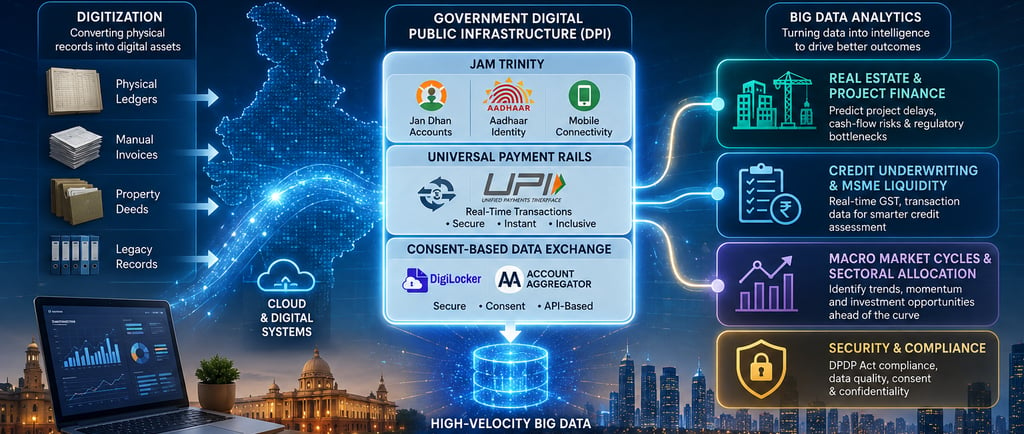
Digitization (The Foundation): This is the baseline process of converting analog, physical information into digital formats. Think of transitioning from physical asset ledgers, scanned property deeds, and manual invoice tracking to cloud-based accounting, automated corporate filings, and unified digital portfolios.
Big Data Analytics (The Intelligence Engine): Once information is digitized across entire industries, it aggregates into "Big Data." Analytics tools look across millions of these data points—corporate balance sheets, historical interest rate cycles, real-time equity market volumes, and credit rating shifts—to uncover hidden macro correlations and actionable trends.
2. The Sovereign Catalyst: The Government Perspective and DPI
What makes the modern Indian data ecosystem unique on a global scale is the proactive role of public policy and digital statecraft. The Government of India has built a population-scale Digital Public Infrastructure (DPI), transforming data from a private corporate silo into a sovereign public good.
The JAM Trinity & Population-Scale Data
The convergence of Jan Dhan accounts, Aadhaar, and Mobile connectivity (the JAM Trinity) laid the ground rails for a cashless, friction-free economy. With over 144 crore Aadhaar numbers generated and billions of monthly transactions flowing through the Unified Payments Interface (UPI), the government has digitized the financial footprints of an entire nation.
Consent-Based Frameworks and Alternative Credit
Through frameworks like DigiLocker (boasting over 67 crore users) and the Account Aggregator (AA) network, the government has institutionalized a secure, consent-based mechanism for data sharing. This means financial data—such as tax filings, bank statements, and business invoices—no longer stays locked inside isolated banking legacy software. It can be instantly synthesized via APIs to underwrite credit or verify corporate health in minutes rather than weeks.
[Sovereign Identity Layer] -> Aadhaar / Biometric Verification
[Universal Payment Rails] -> UPI / Real-Time Transaction Infrastructure|
[Consent Data Exchange] -> Account Aggregators / DigiLocker
Result: High-Velocity Big Data for Analytics
3. High-Value Applications in Corporate Finance and Wealth Advisory
Advanced analytics allows financial strategists to move away from reactive tracking and focus heavily on forward-looking, predictive execution.
Real Estate & Project Finance Analytics
In large-scale corporate financing—such as structured debt, infrastructure funding, or Lease Rental Discounting (LRD)—capital stalls are frequently driven by regulatory or operational lag. By tapping into digitized regional compliance databases, environmental clearance portals, and RERA tracking metrics, big data models allow developers and institutional lenders to forecast cash-flow bottlenecks months in advance, structuring working capital facilities precisely around realistic completion horizons.
Credit Underwriting & MSME Liquidity
Traditional credit assessment often relies on static, historical balance sheets. Today, by leveraging the government's digitized GSTN (Goods and Services Tax Network) rails, big data analytics engines process real-time transaction velocities and payment clearance cycles. This provides a deep, multi-dimensional view of an entity's current liquidity and structural creditworthiness long before traditional credit rating agencies adjust their grades.
Macro Market Cycles and Sectoral Allocation
Markets move in broad, structural cycles. Big data allows asset managers to simultaneously evaluate domestic corporate earnings momentum, sovereign bond yields, and capital expenditures across core sectors like heavy manufacturing, steel, and defense. Instead of investing based on speculative market noise, analytics anchors wealth management to hard, fundamental lead indicators.
4. The Security Mandate: Quality and Compliance
While the convergence of DPI and big data serves as an exceptional multiplier, it introduces rigorous regulatory obligations. Financial and corporate models are highly sensitive to data inputs:
The "Garbage In, Garbage Out" Risk: Flawed data integration or poor internal data quality directly skews algorithmic risk parameters.
The DPDP Compliance Imperative: With the implementation of the Digital Personal Data Protection (DPDP) Act, businesses must ensure that their data harvesting, processing, and analytical modeling adhere to strict statutory mandates surrounding user consent, data minimization, and institutional confidentiality.
Conclusion: Engineering the Future of Capital
Digitization turns on the lights across a company’s operational landscape, but big data analytics maps the exact path forward through complex economic cycles. Backed by a world-class sovereign digital infrastructure, Indian businesses have unprecedented access to structural data insights.
In a volatile financial landscape, relying on intuition or fragmented information is no longer viable. The future belongs to those who utilize structured digital networks to mitigate risk, optimize working capital, and build enduring, resilient wealth.
Strategic Takeaways for Senior Leadership
Leverage the DPI Stack: Transition your internal financial systems to fully interface with Account Aggregator and digital verification rails to eliminate processing friction.
Shift to Predictive Metrics: Move away from lagging accounting metrics (past quarters) and anchor risk models to real-time digital lead indicators (sectoral volumes, GSTN velocity, and credit flow).
Establish Legal Resilience: Ensure your proprietary analytics frameworks are built with privacy-by-design to maintain absolute compliance with modern data protection regulations.